+86-18863350588
 English
 Français
 Deutsch
 Español

Why Airlines and Trains Have Different Cup Requirements Than Cafes
Content
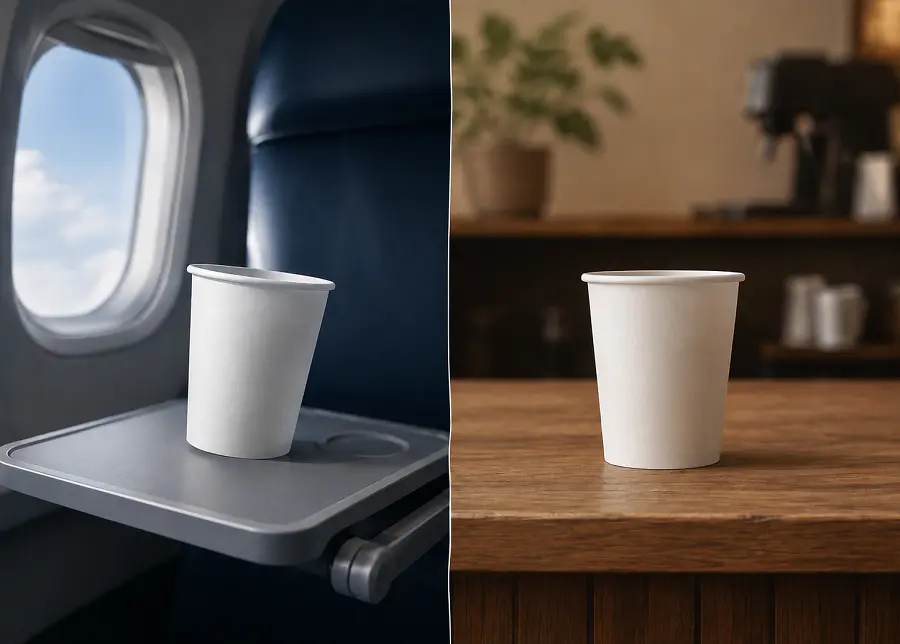
A café can swap cup suppliers in a week. An airline cannot. The reason has less to do with brand loyalty and more to do with what happens to a cup between the moment it leaves the galley cart and the moment it's thrown away — a chain of physical stress and regulatory handling that a coffee counter never has to think about.
The Physical Environment Changes Everything
A café cup sits on a flat counter for a few minutes before it's handed off. A cabin cup gets loaded into a beverage cart, wheeled down an aisle during light turbulence, poured mid-air, and often set on a fold-down tray table that isn't perfectly level. That sequence puts far more mechanical stress on the cup body and the wall construction that determines rigidity and insulation than a normal retail handoff ever will.
Rim stability matters more too. A cup that wobbles slightly on a café counter is a minor annoyance; a cup that wobbles on a beverage cart moving through the aisle during service is a spill risk with a passenger sitting a few inches away. That's why cabin-grade cups are typically specified with tighter tolerances on rim roundness and base flatness than a standard foodservice cup, and why lid seal engineering gets scrutinized far more closely on transit orders. Rail service has a lighter version of the same problem — lateral sway on a moving train, narrow aisles, and a trolley cart that a server pushes one-handed while balancing on a slightly rocking floor.
Waste Streams Follow Different Rules
A café throws its used cups in the same bin as everything else, and the local waste hauler decides what happens next. Airlines don't get that option on international flights. Many countries classify catering waste from inbound international flights as a biosecurity risk, on the theory that any packaging that touched food or dairy could carry animal disease. Under that framework, cups used to serve milk-based drinks are frequently barred from recycling programs entirely and routed straight to incineration, regardless of what the cup is made of.
This is not a minor technicality. It means a fully compostable or FSC-certified cup can still end up incinerated on an international route simply because of where the flight originated, not because of anything wrong with the material itself. Airlines sourcing packaging for global routes have to think about this reality up front, which is one reason certification and sourcing documentation matters even when the destination market won't actually let the cup be recycled. Train operators, by contrast, almost always fall under ordinary domestic waste rules, so a rail cup program has more freedom to lean into compostable or recyclable formats without hitting the same regulatory wall.
Weight, Stackability, and Cart Loading Change the Spec
Every gram loaded onto an aircraft burns fuel across the life of that flight. A cup that's a fraction heavier than necessary doesn't matter on a café shelf, but multiplied across thousands of cups on a long-haul flight and thousands of flights a year, it becomes a real cost line for procurement teams. That pushes airline cup specs toward the lightest paperboard that still holds its shape under load — a very different optimization target than a café, where a heavier, more premium-feeling cup is often a selling point.
Stackability is the other constraint café buyers rarely think hard about. Galley carts have fixed drawer heights, and a cup that nests a few millimeters looser than spec can throw off the stack count for an entire cart, which then throws off catering load planning for the flight. That level of dimensional consistency is closer to what airlines expect from a premium finished cup line built for controlled service environments than from a generic stock item, and it's also why airline branding programs tend to favor custom printed cups produced under tight tolerance rather than off-the-shelf branded stock. Cold beverage service adds another layer, since inflight drink carts also need to run cold drink cup formats that hold their rigidity at cabin temperature without sweating onto the tray.
What This Means for Sourcing a Transit-Grade Cup
Buyers moving from café-grade to transit-grade packaging should treat it as a different specification exercise, not a scaled-up version of the same order. A few checks matter more here than in standard foodservice sourcing:
- Confirm stack height and nesting tolerance against actual cart drawer dimensions, not just cup diameter on a spec sheet
- Test rim and base rigidity under a filled, tilted, and lightly jostled condition, not just a static fill test
- Ask the supplier directly whether the waste destination market treats catering packaging as recyclable, since international catering waste regulations can override any compostability claim on the cup itself
- Verify per-unit weight against the fleet's fuel-cost model, not just unit price
- For rail programs, confirm the cup meets domestic recycling standards rather than assuming aviation-grade specs apply
None of this makes a café cup inferior. It simply means café requirements were never designed to survive a beverage cart, a customs regulation, or a fuel-burn calculation — and treating the two sourcing problems as interchangeable is where most transit packaging programs run into trouble.