+86-18863350588
 English
 Français
 Deutsch
 Español

Why Disposable Cutlery Kits Are the Hardest Item to Go Plastic-Free
Content
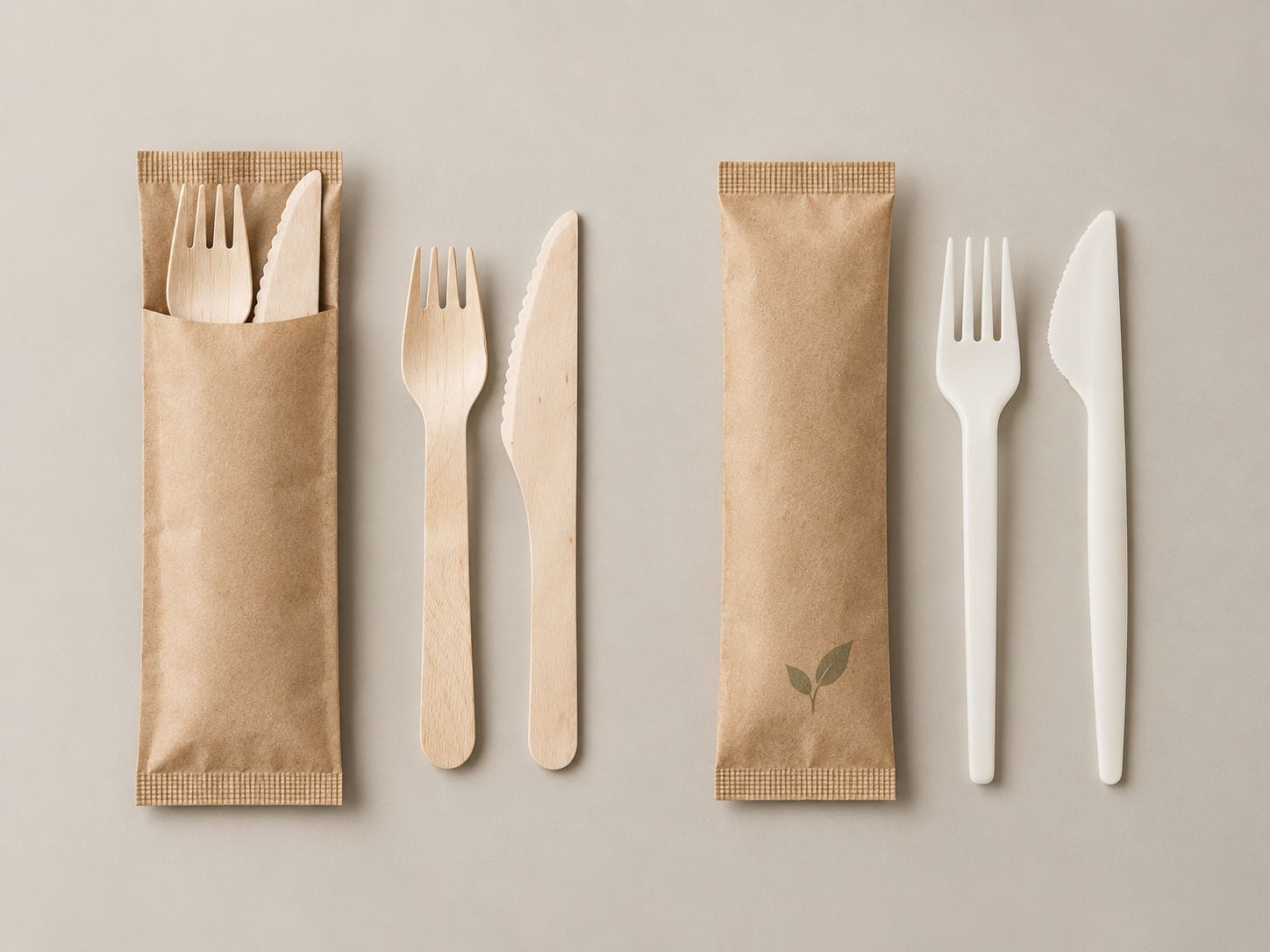
The Problem Isn't the Material — It's the Job the Material Has to Do
A catering operator can swap every cup, lid, and straw on a buffet line for a plastic-free version without changing how a single meal gets eaten. Swap the fork, and the meal itself is on the line. A spoon has to hold its shape through a bowl of hot soup. A knife has to cut through a chicken breast without folding in half. Cups and containers mostly need to hold still. Cutlery has to perform under load, every time, or it fails at the one job it exists to do.
That mechanical demand is why cutlery kits sit at the difficult end of the plastic-free spectrum. Materials that break down easily after use tend to be softer while they are still in use, and early plant-fiber utensils earned a reputation for flexing or twisting the moment they met real resistance. Getting rigidity and biodegradability into the same object, at a price that still works for foodservice, has taken longer to solve than almost any other single-use item.
A Kit Is Several Products Pretending to Be One
A fork, a knife, a spoon, a napkin, and the pouch holding them together rarely come from one material decision. A cutlery kit is several products bundled into a single unit, and each one carries its own plastic-free status independently of the others.
Compostability standards treat that bundling literally. Under the EN 13432 disintegration and biodegradation test criteria, a packaging item made of multiple components is only considered compostable as a whole if every one of those components clears the criteria on its own — a coating on one piece, or a plastic window in a paper pouch, is enough to disqualify the whole kit. For a single-material product, that arithmetic is simple. For a kit, it means the fork, the spoon, the knife, and the carrier all have to clear the bar together, not just the utensils people notice first.
Two Working Paths: Wood and PLA
In practice, two material approaches meet the strength requirement without falling back on petroleum-based plastic.
Birch wood cutlery kits with no coatings or added wax are one path. Cut and shaped from a single piece with nothing applied to the surface afterward, wood holds a clean edge and resists warping under pressure — and with no separate coating layer, there's nothing extra to disqualify the claim later on.
Thickened, food-grade PLA cutlery kits are the other. Made from corn starch rather than petroleum, PLA can be molded with enough wall thickness to hold rigidity through cutting and scooping while staying compostable and safe for direct food contact. The trade-off has less to do with performance than disposal infrastructure: PLA still needs the same industrial composting conditions any EN 13432-certified material requires, so it fits best where that end-of-life pathway already exists.
Neither material behaves exactly like the plastic it replaces, so the utensil design works around that difference rather than against it: radius-edged, polished pieces that pass the same product testing a plastic version would, without borrowing the plastic itself.
Kit composition adds another variable on top of material choice. A three-piece set covers the basics of a quick meal, while a five-piece set with a napkin and a stir stick suits a fuller catering order. Because the utensils, carrier, and any branding are assembled before the kit ships, the piece count and an embossed logo on the pouch can be adjusted without touching the material decision that keeps the whole thing plastic-free.
The Carrier Matters as Much as the Fork
The utensils get most of the attention, but the pouch they arrive in is doing real work too. A cutlery kit headed for takeout has to survive contact with hot, oily food without leaking through, which is why a kraft paper carrier with a PE-laminated interior is common — it holds up against oil and moisture at temperatures up to 248°F.
That lamination is exactly the kind of component EN 13432 flags. A thin plastic film, even one this small, changes what the finished kit is allowed to claim. Pairing a compostable utensil with a carrier engineered to the same compostable or plastic-free standard, rather than treating the pouch as an afterthought, is what keeps a plastic-free claim intact from the fork to the packaging around it.
Certification Is the Only Way to Prove It
None of this is verifiable by looking at a fork. Whether a kit is genuinely plastic-free, where the wood or the corn starch came from, and whether the finished product actually meets disintegration and biodegradation thresholds sits behind paperwork, not appearance.
That is why FSC, EUDR, and PEFC sourcing requirements for catering supplies procurement, alongside quality and environmental management systems like ISO 9001 and ISO 14001, matter more for cutlery kits than for most packaging categories. A buyer evaluating a kit is not checking one material decision; they are checking a forest source, a molding process, a lamination layer, and a supply chain, all at the same time.
For a category with this many moving parts, that documentation is not bureaucracy. It is the only mechanism that makes a plastic-free claim on a cutlery kit mean what it says, from the tip of the fork to the seam of the pouch it ships in.