+86-18863350588
 English
 Français
 Deutsch
 Español

Ultrasonic Side Seams in Paper Cups: How Leaks Start and Get Caught
Content
- 1
- 2 Why the Side Seam Is Where Cups Fail
- 3 How Ultrasonic Heat-Pressing Seals the Seam
- 4 The Three Ways a Seam Leaks
- 5 Catching Defects on the Machine
- 6 Human Checks Layered on Top
- 7 Water Tests Under Real Conditions
- 8 Final Checks Before the Truck
- 9 Tracing a Carton Back to Its Machine
- 10 Questions to Ask Any Cup Supplier
Why the Side Seam Is Where Cups Fail
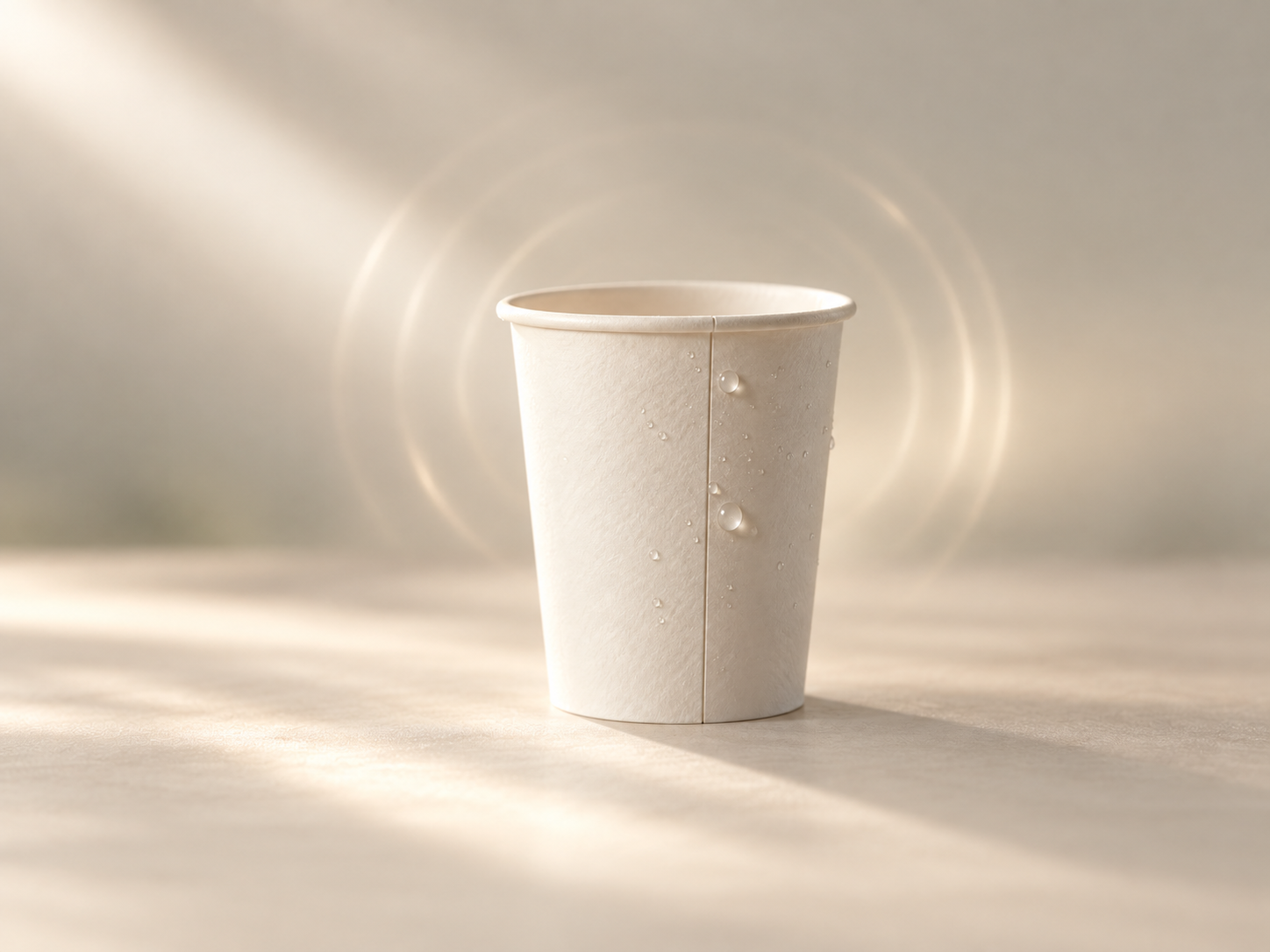
A paper cup body is one sheet of coated board rolled into a cone. Everywhere except one narrow strip, the wall is a single layer. Along the side seam, two layers overlap and have to fuse into a watertight joint. That strip is the most common starting point for a leak.
A seam can look perfect on the line and still fail an hour later in a customer's hand. Preventing that takes a sealing process that works and a quality system that catches the cups where it did not.
How Ultrasonic Heat-Pressing Seals the Seam
In ultrasonic sealing, high-frequency vibration is applied to the overlapping edges. The vibration creates friction heat inside the overlap, which softens the barrier coating. Pressure then presses the softened layers together, and they bond as they cool.
Hot-air sealing reaches the same result differently. It heats the seam surface with a stream of hot air before pressing. Both methods can produce a sound seam on a well-tuned machine. The difference is where the heat comes from and how tightly it can be controlled, which is why settings and inspection matter more than the label on the process.
Our forming lines use an ultrasonic heat-press process at the side seam. You can see how this fits into the wider production setup on our paper cup manufacturing capabilities page.
The Three Ways a Seam Leaks
Most seam failures fall into three patterns, each with a different cause and a different visible clue.
| Failure | Typical cause | What you may see |
|---|---|---|
| Wrinkling | Board shifts or folds during forming | Ridges or a visible crease along the seam |
| Edge seepage | Raw board edge exposed to liquid | Dark, damp line at the seam edge |
| Bottom joint leak | Poor bond where wall meets base | Slow drip from the lower edge |
Layer separation after storage is a related problem. If you want to see how moisture and aging play into it, read why paper cups crack or delaminate.
Catching Defects on the Machine
The first filter works at machine speed. An AI vision system with Japanese-made cameras inspects each cup as it forms and screens automatically for three problems: rims that are out of round, defects on the cup body, and defects on the cup bottom. A cup that fails the check is pulled out of the flow.
Automated inspection is consistent and never gets tired, but it only judges what a camera can see. That is why it is the first layer, not the only one.
Human Checks Layered on Top
The machine crew checks 10 cups from every carton they pack. Separately, the QC team makes a round of every machine once an hour and inspects finished cups from each one.
Two sets of human eyes serve different purposes. Operators catch problems at the moment of packing. QC inspectors work independently of production pressure and can spot drift, such as a machine slowly moving off its settings, before it grows into a bad batch.
Water Tests Under Real Conditions
Visual checks cannot prove a seam holds liquid. So every machine goes through a leak test every two hours: 20 cups are pulled and filled with a test liquid.
The liquids are chosen to reflect the range of what cups meet in service:
- Boiling water at 100°C: a worst-case heat load for the coating and seam.
- Coffee at 92°C: close to the temperature at which many cafes serve.
- 75% alcohol: a strong solvent that probes the coating and seam in a way plain water does not.
Testing every machine on a fixed schedule means a drift in seam quality is found within hours, not after a pallet has shipped. Learn more about the standards behind these checks on our quality control and testing page.
Final Checks Before the Truck
Cups that pass the line are not shipped on that basis alone. After the QC team signs cartons into the warehouse, a further sample is checked. A second inspection takes place before loading.
The two gates serve different risks. The warehouse check confirms what was produced. The pre-loading check confirms that nothing changed in storage and handling, and that the cartons going onto the truck match the approved stock.
Tracing a Carton Back to Its Machine
Cameras cover the forming area, the warehouse and the loading area. Every carton carries a serial number. Combined, these allow each carton to be traced from the truck back through storage to the machine and time period that made it.
For a buyer, traceability changes how problems are handled. If a customer reports leaking cups, the investigation can start from one carton number rather than a whole shipment. That narrows the question to a machine, a shift and a time window, and it shows whether the issue was isolated or systemic.
Questions to Ask Any Cup Supplier
Whatever the sealing method, a supplier's answers to these questions say more about reliability than a brochure does:
- How often is each machine tested for leaks, and with what liquids and temperatures?
- Is inspection automated, manual or both, and who checks the checkers?
- Is there a separate inspection after warehousing and before loading?
- Can a single carton be traced back to its machine and production time?
- What happens to a lot when a test fails: is it quarantined, re-inspected or scrapped?
The right answers matter most for products that face heat and liquid all day, such as single wall paper cups, double wall paper cups and cold drink paper cups. For a broader look at what goes wrong with disposable containers and how testing finds it, see why paper containers leak, smell or soften.