+86-18863350588
 English
 Français
 Deutsch
 Español

Why Paper Cups Crack or Delaminate — And Why It's Rare
Content
Cracking Isn't Normal for a Paper Cup
It's easy to assume a paper cup is a short-lived, disposable object by nature — something that's expected to crack, peel, or delaminate after a bit of handling. That assumption is wrong more often than people think. A paper cup made from standard basis weight paperboard, produced correctly, doesn't crack or delaminate under normal use. When it does happen, there's almost always a specific, identifiable cause behind it — not random wear.
Special Finishes Put Stress on Paper the Base Stock Wasn't Built For
The most common cause isn't the paper itself — it's what gets applied on top of it. Gloss varnish, 3D embossed shapes, and raised UV coating effects all add a distinct surface layer over the printed design. That extra layer changes how the paper behaves when it's curled, folded, or formed into a cup shape.
Each of these finishes creates a stiffer, less flexible zone on the surface of the paper. When the base stock underneath still needs to bend and curl during forming, that mismatch is exactly where fine cracks and creases tend to show up. This is the trade-off customers take on when they choose premium finish options refined for curved cup surfaces — the visual impact is real, but so is the added stress on the paper. The same applies to gold and silver lining finishes for high-end print effects, where a metallic accent layer sits on top of the print and behaves differently from the paper fibers underneath it during the curling and seaming steps.
What's Inside the Paper Matters as Much as What's Printed on It
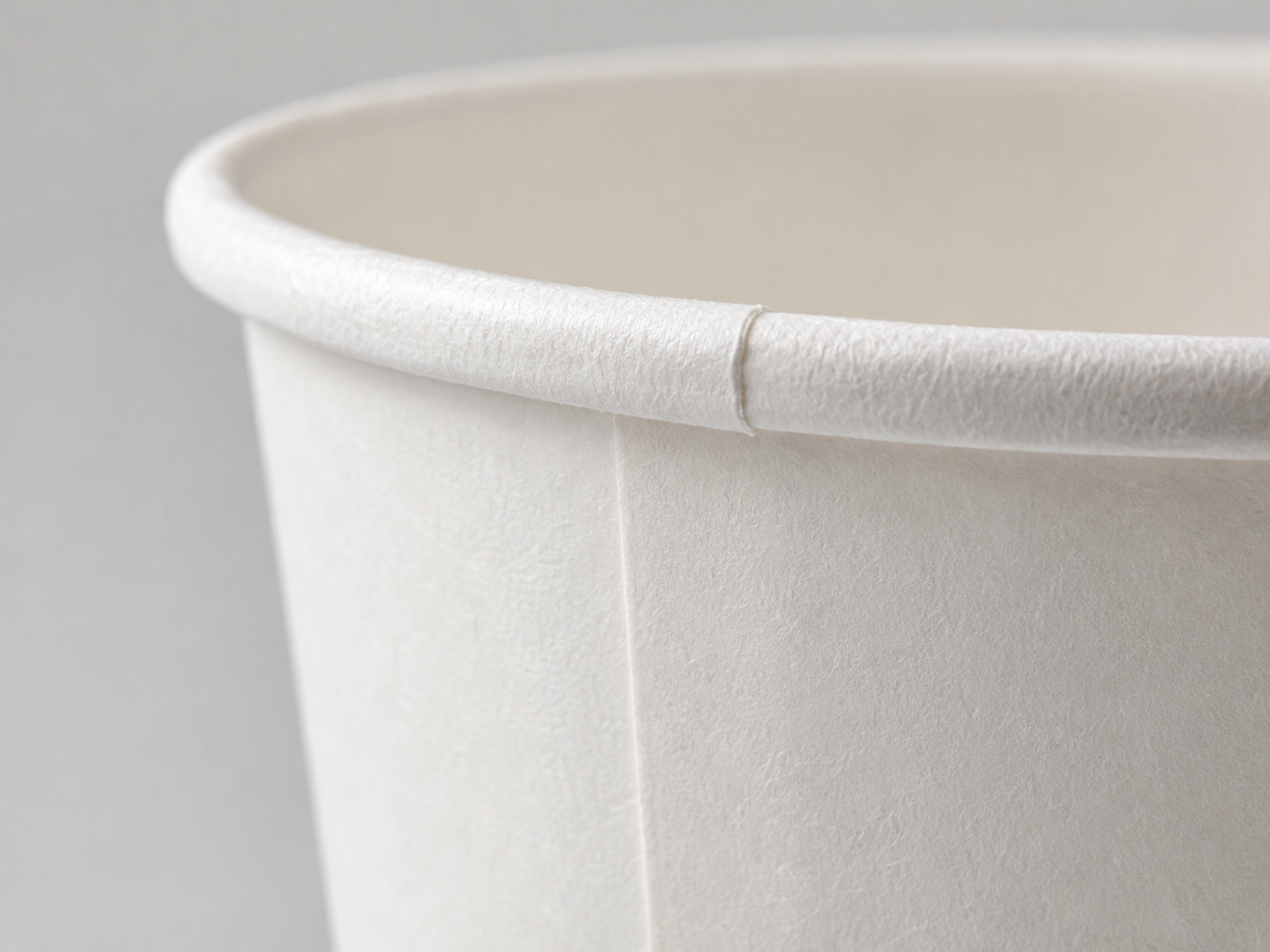
Surface finishes only tell part of the story. The paper itself — specifically its fiber content and fiber length — plays just as large a role in whether a cup holds up or fails. Longer fibers create a more interlocked, resilient sheet structure, which translates directly into higher bending stiffness and better resistance to cracking at the seam and rim curl, the two points where a cup is put under the most mechanical stress during forming.
This isn't just a manufacturing preference — it's been studied directly. A peer-reviewed study on paperboard material properties found that bending stiffness and delamination strength were among the key factors affecting how a cup's side seam and rim roll perform during high-speed forming, independent of the coating applied. In other words, two cups can carry the exact same PE coating and still behave very differently once they're formed, purely because of what the base paper is made of. That's the variable that's easy to overlook when a cup is being evaluated on print quality alone.
Built for More Than One Use
The industry default is to treat a paper cup as a single-use item, used once and discarded. That default isn't a technical requirement — it's a byproduct of using lower-grade paper stock that isn't built to survive more than one cycle of handling and washing. A cup made with longer fiber content and consistent basis weight can hold up to repeated handling without the seam weakening or the rim losing its shape.
Getting there depends on two separate things working together. The first is what happens before the paper ever reaches the factory: sourcing base paper from established mills whose fiber length, food-grade certification, and packaging compliance meet a consistent standard, rather than accepting whatever stock is cheapest that quarter. The second is what happens on the factory floor, where in-house printing and coating processes tested before mass production catch the kind of forming defects — weak seams, uneven curling, inconsistent coat weight — that would otherwise only show up after a cup has already shipped.
Cups built this way, at standard basis weight with adequate fiber length and food-grade materials, hold up to everyday reuse in office and household settings — multiple fills, no leaking, no loss of shape — without needing a specialty coating or a premium price tag to get there. It's less about adding something extra and more about not cutting corners on the fundamentals in the first place.