+86-18863350588
 English
 Français
 Deutsch
 Español

How to Find the Ultimate Paper Bowls?
Content
- 1
- 2 I. Start with the real use case and service conditions
- 3 II. Lock down bowl size, dimensions, and fill line
- 4 III. Select paperboard grade and barrier coating based on food chemistry
- 5 IV. Define performance requirements suppliers can test
- 6 V. Set compliance, safety, and labeling expectations early
- 7 VI. Specify customization details that affect cost and lead time
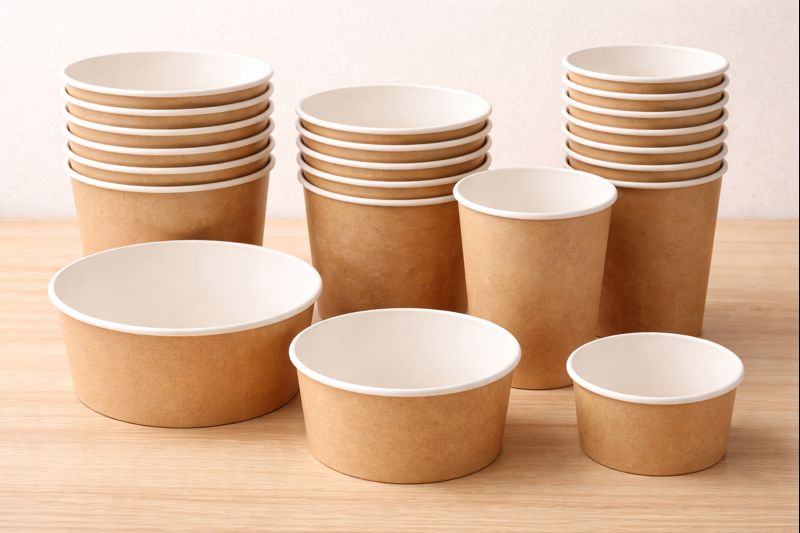
I. Start with the real use case and service conditions
Before you request quotes, document exactly how the custom paper bowls will be used: the type of food to be held, food retention time, and temperature range. These factors drive paper bowl shape, paper coating, and test standards more than design elements.
Common scenarios to specify
- Hot soups/ramen (high heat + long hold time)
- Oily foods (poke, curries, stir-fry) that can wick through low-barrier paper
- Cold/frozen items (ice cream, smoothie bowls) where condensation is the problem
- Delivery and stacking (compression, vibration, and lid fit matter)
A practical baseline is to define the operating window as food temperature, hold time, and transport method. For example: “95°C soup, 30-minute hold, delivery in insulated bag, no external sleeve.”
II. Lock down bowl size, dimensions, and fill line
Suppliers can’t quote accurately without a clear dimensional target. “12 oz bowl” can refer to brimful capacity, usable capacity, or a marketing size. Define both the volume and the geometry so lids, stacking, and portioning work consistently.
Capacity definitions that prevent mistakes
- Brimful capacity: volume to the very top edge (useful for engineering, not portioning)
- Fill-line capacity: volume to a practical level that avoids spills (recommended to specify)
- Headspace: the gap between fill line and rim for lids and sloshing (often 8–15 mm depending on product)
A simple dimensional spec you can send
- 1. Top diameter (mm) and bottom diameter (mm)
- 2. Height (mm)
- 3. Fill-line capacity (mL/oz) and brimful capacity (mL/oz)
- 4. Lid requirement: “no lid,” “flat lid,” or “dome lid,” plus lid material preference
If you are replacing an existing container, send a photo next to a ruler and request “match these dimensions within ±2 mm” to reduce sampling cycles.
III. Select paperboard grade and barrier coating based on food chemistry
Disposable paper bowls typically use paperboard plus a coating layer to resist water, oil, and heat. Your requirement should state the paperboard basis weight and the coating type, because these determine rigidity, leak resistance, environment-friendly claims, and unit cost.
Typical spec ranges to discuss with suppliers
- Paperboard: often ~240–350 gsm depending on bowl size and stacking needs
- Single vs. double coating: single for moderate moisture; double for high heat/long hold soups
- Barrier types: PE (common, economical), PLA (bio-based, heat limits vary), or water-based dispersion coatings (varies by supplier)
Use your product as the driver: oily broths and curries typically need stronger grease resistance than salads, while ice cream bowls may prioritize condensation control and stiffness at low temperatures.
| Food / Use | Main Risk | What to Specify | Example Target |
|---|---|---|---|
| Hot soup / ramen | Heat + soak-through | Double barrier, higher gsm, heat/hold tests | 95°C, 30–60 min, no leaks |
| Curry / oily meals | Grease migration | Grease resistance, seam integrity | Oil exposure 30 min, no staining |
| Ice cream / cold bowls | Condensation + softening | Low-temp stiffness, condensation tolerance | -10°C to 5°C, firm walls |
| Delivery / stacking | Crush + lid pop-off | Compression, stack height, lid fit | 10-high stack, stable |
IV. Define performance requirements suppliers can test
“No leaks” is not a requirement unless it includes conditions and duration. Convert expectations into measurable criteria so the supplier can run repeatable tests during sampling and production.
Performance items worth specifying
- Leak resistance: water at target temperature held for a defined time (for example, 60 minutes)
- Seam integrity: no pinholes or delamination at side seam or bottom edge
- Heat handling: bowl remains rigid and comfortable to hold (or state “requires sleeve”)
- Grease resistance: oil exposure without visible staining or softening over a set duration
- Microwave tolerance (if needed): time/power conditions and pass/fail criteria
A strong requirement statement includes the condition and the limit, such as: “No leakage after 45 minutes holding 90°C soup at fill-line capacity.”
V. Set compliance, safety, and labeling expectations early
Environment protection regulation and claim requirements of your market will constrain the paper materials and printing inks, that should be clarify before making samples.
Requirements to put in your RFQ
- Food-contact compliance documentation applicable to your market (ask supplier which standard they certify to)
- Ink safety for food packaging (low-odor, low-migration inks where applicable)
- Any “compostable,” “recyclable,” or “plastic-free” claims you intend to print (these must match the actual construction)
- Traceability: production date code or lot marking location
If you plan to make sustainability claims, require the supplier to confirm the bowl structure in writing (paperboard + coating type) and provide supporting documentation. The most common pitfall is printing a claim that the final construction cannot support.
VI. Specify customization details that affect cost and lead time
Custom paper bowls are priced and scheduled based on printing complexity and tooling. If you define artwork and printing requirements clearly, suppliers can quote correctly and avoid change orders.
Printing and branding requirements to define
- Number of colors and whether you need full-wrap printing
- Logo placement constraints (keep-out zones near rim, seam, and bottom curl)
- Finish expectations (matte vs glossy appearance), if offered
- Color matching tolerance (for example, “brand color to approved proof; minor batch variation acceptable”)
To reduce risk, request a printed pre-production proof and require sign-off before mass production. The requirement can be as simple as: “Mass production only after approved printed proof.”
To reduce risk, request a printed pre-production proof and require sign-off before mass production. The requirement can be as simple as: “Mass production only after approved printed proof.”
With all these customization details clarified and the pre-production proof process in place, you’re all set to kick off your order. Reach out to YONGRUI PACK today to get a precise quote and lock in your ideal lead time—let’s turn your perfect custom paper bowls into reality.