+86-18863350588
 English
 Français
 Deutsch
 Español

Boba Straw Size & Material Guide for Bubble Tea Shops
Content
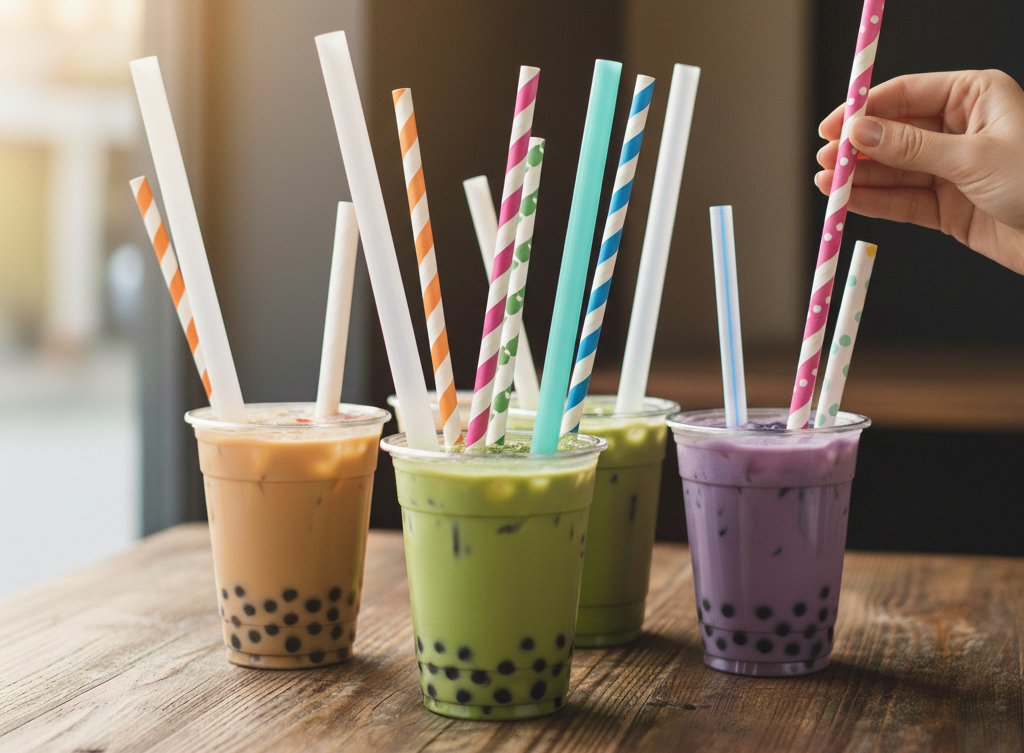
Why boba straw size and material matter in a shop
For bubble tea, the straw is part of the product experience and part of your operational reliability. If the straw is too narrow, toppings jam and drinks get returned; if it is too wide or too long, costs rise and sealing/fit problems show up at peak hours.
A practical rule of thumb is to size for the largest topping you serve. Typical tapioca pearls are often around 8–10 mm in diameter, so many shops standardize on “fat” boba straws with an inner diameter that provides clearance for pearls plus syrupy flow.
Material matters just as much: it affects rigidity (piercing film lids), mouthfeel, storage stability, and whether the straw softens in cold drinks over time.
Choosing the right straw diameter for boba
Start with inner diameter (ID), not outer diameter (OD)
Suppliers may list OD (outer diameter) because it is easier to measure, but drink performance depends on ID (inner diameter). Two straws with the same OD can have different IDs if their wall thickness differs.
For boba pearls near 8–10 mm, a common operational target is ≥11–12 mm ID to reduce jamming risk and make sipping effortless for customers.
Match diameter to toppings and drink viscosity
- Classic tapioca pearls only: aim for 11–12 mm ID for smooth flow and low clogging.
- Mixed toppings (pudding cubes, jelly, fruit bits): consider 12–13 mm ID to handle irregular shapes.
- No toppings (milk tea only): 8–10 mm ID is usually sufficient, but many shops still standardize on one boba size for simplicity.
- Thicker blends (taro, smoothie-style): wider straws reduce effort; choose 12–13 mm ID if the drink is notably viscous.
A simple clearance rule for fewer clogs
If you regularly see clogging, increase clearance. A practical approach is to keep straw ID at least ~2 mm larger than your largest round topping. Example: if pearls average about 9 mm, targeting ~11 mm ID meaningfully lowers the chance a pearl wedges sideways.
| Menu situation | Suggested ID range | Why it works |
|---|---|---|
| Standard pearls (8–10 mm) | 11–12 mm | Good clearance; low clogging; familiar mouthfeel |
| Mixed/irregular toppings | 12–13 mm | Handles cubes/jelly; reduces “stuck topping” complaints |
| No toppings (tea only) | 8–10 mm | Lower cost option if you stock a separate straw |
| Thick blends (smoothies/taro) | 12–13 mm | Less suction needed; faster service and better satisfaction |
Choosing straw length for cup sizes and sealing styles
Length affects usability and leakage risk. Too short and customers struggle; too long and it tips, splashes, or ships poorly. For film-sealed cups, you also want enough length to reach the bottom comfortably after piercing.
Practical length ranges most shops use
- 12–16 oz cups: 180–200 mm straws often fit well and feel balanced.
- 20–24 oz cups: 210–230 mm straws reduce “can’t reach the bottom” complaints.
- Domed lids or tall specialty cups: consider 230+ mm so customers can sip without awkward angles.
Quick fit check (useful for purchasing)
A simple in-shop test is to insert a straw to the bottom of a filled cup and confirm the top extends above the lid by roughly 30–60 mm. This range is typically comfortable to hold and sip without the straw falling into the drink.
| Cup format | Typical volume | Common straw length | Notes |
|---|---|---|---|
| Standard cold cup + film seal | 12–16 oz | 180–200 mm | Balanced feel; easier storage |
| Large cold cup + film seal | 20–24 oz | 210–230 mm | Reduces “short straw” feedback |
| Dome lid / tall specialty cup | Varies | 230+ mm | Check packaging constraints before buying |
Material guide: what straw material is suitable for boba
For bubble tea shops, a “suitable” straw material must do three things: stay rigid enough to pierce a film lid, remain stable in cold drinks over the full consumption window, and align with your cost and sustainability requirements.
Plastic options (PP and PET) for reliability and piercing
If your priority is consistent performance, PP (polypropylene) boba straws are widely used because they are tough, resist cracking, and pierce film seals reliably. PET can also be used, but stiffness and cracking behavior varies by supplier and wall thickness.
Operational advantage: fewer slowdowns at the sealing station because the straw tip stays sharp and does not buckle.
Paper straws: often unsuitable for boba unless engineered
Standard paper straws frequently soften and deform, especially with thicker drinks and long sip times. For boba, only consider paper if it is explicitly designed for “bubble tea” use (reinforced walls, coating suitable for cold beverages) and you validate performance in your own drinks.
If you choose paper, test for: (1) piercing success rate on your film, (2) softening after 30–60 minutes in your most popular drink, and (3) whether the inner wall frays and catches toppings.
PLA and other compostables: workable with careful testing
PLA (polylactic acid) straws can perform well in cold drinks, but performance depends heavily on formulation and wall thickness. They are typically less heat tolerant, but bubble tea is usually served cold, making PLA a feasible option when local policy or brand positioning requires compostable materials.
The key is to validate rigidity for film piercing and ensure the straw does not crack under normal customer use. Ask suppliers for specs on diameter tolerances and brittleness, then run in-store trials.
Reusable options (stainless steel, silicone): niche but brandable
Reusable straws can support merchandising and sustainability branding, but they introduce sanitation responsibilities and customer adoption hurdles. Silicone is gentler on teeth and handles boba well; stainless steel is durable but can be uncomfortable and is not appropriate for all customers.
| Material | Pierces film lids | Cold drink stability | Best use case |
|---|---|---|---|
| PP (plastic) | Excellent | Excellent | High-volume shops prioritizing speed and consistency |
| PLA (compostable) | Good (varies) | Good in cold drinks | Policy-driven or eco-positioned menus (validate by testing) |
| Paper (standard) | Often poor | Often degrades over time | Only if engineered for boba and proven in your drinks |
| Silicone (reusable) | Not for film lids | Excellent | Retail add-on; customers who prefer softer mouthfeel |
| Stainless steel (reusable) | Not for film lids | Excellent | Merchandising; durability-focused customers |
A practical purchasing guide for shops
Standardize where possible to reduce complexity
Many shops simplify operations by stocking one “default” boba straw that works for most drinks (for example, ~12 mm ID and an appropriate length for the most common cup). Standardization reduces ordering mistakes, speeds training, and improves consistency at the sealing station.
Ask suppliers the right questions (and verify)
- Is the listed diameter ID or OD, and what is the tolerance (how much it can vary)?
- What is the wall thickness, and does it buckle when piercing your exact film seal?
- How is the tip cut (sharp angle vs flat), and is it consistent batch to batch?
- What are the packaging and storage requirements (humidity, heat) for the chosen material?
Do a simple in-store validation before committing
- Piercing test: seal 20 cups and confirm the straw pierces cleanly without bending; target near-zero failures during normal use.
- Clog test: sip drinks with your top 3 toppings; confirm pearls and jelly pass smoothly without repeated tapping.
- Time test: leave a straw in a finished drink for 45 minutes and check for softening, cracking, or taste transfer.
- Customer handling: verify the straw doesn’t split at the top edge during normal chewing/sipping behavior.
Common mistakes (and how to avoid them)
- Buying based on OD only: confirm inner diameter so pearls actually fit.
- Underestimating mixed toppings: if you sell jelly/pudding, size up to reduce peak-hour remakes.
- Choosing paper without a time test: softening after 20–60 minutes can create negative reviews even when the drink tastes great.
- Mismatch with lids/seals: ensure your straw tip and rigidity match the exact film or lid you use.
Bottom line: for most bubble tea shops serving standard pearls, a reliable starting point is a rigid boba straw around 11–12 mm ID and a length matched to your primary cup size, validated through quick in-store tests.