+86-18863350588
 English
 Français
 Deutsch
 Español

Best Disposable Bowls for Hot Soup: Materials, Lids & Testing
Content
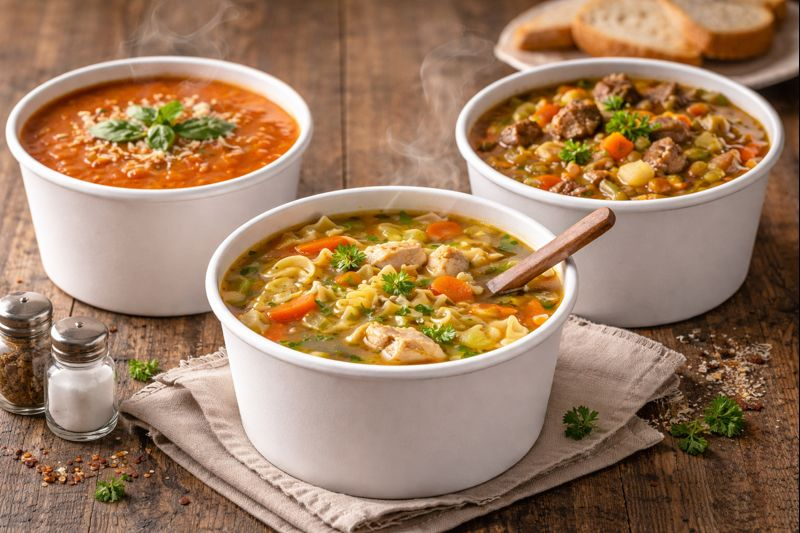
Choosing the best disposable bowls for hot soup is less about “one perfect bowl” and more about matching materials, coatings, lid fit, and quality checks to your real service conditions—dine-in, takeaway, or delivery.
As a packaging manufacturer and supplier, we typically evaluate soup bowls around three points: leakage at seams, the carrying capacity of the paper bowls, and the durability of the rolled edges of the paper bowls.. Lets see how to define the “Best Paper Bowls “.
What “Best” Means for Hot Soup Bowls in Real Use
For hot soups and porridge, a bowl is “best” when it stays rigid, contains hot liquid reliably through the full serving window. The most practical target is preventing the two common incidents: seepage during delivering and bottom deformation during carrying.
Three performance outcomes to prioritize
- Leak resistance: The firmness of the side seams and the shape of the rim of the paper bowl must be able to prevent leakage, especially when dealing with oily soups or acidic soup dishes.
- Load-bearing stability: The thicker paperboard can prevent the bottom of the paper bowl from sinking when it is filled with hot food and soup products for a long time and can be easily removed.
- Heat retention: The bowl, when combined with an appropriate lid, can ensure food clean and temperature change during delivery and distribution.
If you are sourcing for delivery, favor designs that remain sturdy under high-temperature foods or fresh salad in refrigerator. A single-layer bowl can still perform well when paired with a high-strength food-grade coating and correctly engineered rim/lid fit.
Paper, Coating, and Why Board Weight Matters for Soup
In hot soup applications, paperboard grade and food-contact coating drive most outcomes. A heavier board improves rigidity and reduces the “floppy bowl” feeling that customers associate with low quality.
Board weight guidance you can specify
For high-temperature soups, buyers commonly choose paperboard in the 200–350 g/m² range, and for delivery it is prudent to request ≥250 g/m² to reduce bottom sag during handling.
Coating selection: match it to holding time and sustainability claims
- PE: dependable for short-term hot liquid containment and commonly selected for performance-first soup service.
- PLA: often chosen where the market have environmental degradation requirements, generally for fresh salad.
- Aqueous coatings: typically used to balance barrier performance and end-of-life goals; validate with hot-fill tests based on your soups.
- Low-PE options (e.g., PE < 5%): can be specified where you want reduced plastic content while maintaining practical leak resistance.
Size, Capacity, and Geometry: the fundamental of paper bowls
“Best disposable bowls for hot soup” also means choosing a capacity that fits your menu and fill line. Overfilling is a major cause of lid leakage, courier spills, and messy unboxing—even when the bowl itself is well-made.
| Nominal Capacity | Top (mm) | Bottom (mm) | Height (mm) | Pack (pcs/bag; qty/ctn) | Best-fit Use Case |
|---|---|---|---|---|---|
| 700 ml | 135 | 110 | 70 | 50; 300 | Standard soup portions, side soups, porridge |
| 850 ml | 135 | 105 | 90 | 50; 300 | Hearty soups, noodle soups with toppings |
| 980 ml | 135 | 102 | 102 | 50; 300 | Large portions, combo meals, longer delivery routes |
Practical sizing tips that prevent spills
- Set a fill line that leaves head space for sloshing (especially for couriers on bikes/scooters).
- For soups with noodles/toppings, choose a deeper bowl to reduce overflow when customers stir.
- Keep the paper bowls’ top diameter consistent if you want one lid to fit multiple capacities; it simplifies inventory and reduces wrong-lid incidents.
Lids, Rim Fit, and Delivery Handling: Where Most Complaints Come From
Even a strong bowl can fail in the customer’s hands if the lid fit is inconsistent. For hot soup, prioritize a leak-resistant lid interface: reinforced rolled rims increase retention force and provide a stable mating surface for lids.
Specify lid performance, not just “with lid”
- Include top diameter, rim thickness and the exact lid model in your purchase specification.
- Stronglu recommend that sourcing the paper bowls and paper lids from the same supplier to ensure the compatibility of the products
- State maximum fill temperature and expected hold time so coating and seam sealing can be validated under real conditions.
If you are building a consistent takeaway program, it can be helpful to source bowls and related packaging as a system (bowls, lids, carriers). You can browse broader bowl options here: disposable paper bowls range.
Food Safety, Compliance, and Supplier Credibility Signals
When you are buying disposable soup bowls at scale, quality systems matter as much as the bowl design. Look for suppliers who can provide third-party testing and recognized management certifications, and who can document consistent raw material control.
Documents you may be able to request
- Food-contact compliance documentation for coatings and inks relevant to your market (e.g., EU or FDA frameworks).
- Third-party test reports (e.g., from SGS) for safety and/or performance verification when applicable.
- Quality management and food safety certifications (examples buyers commonly recognize include ISO and BRC).
- FSC chain-of-custody documentation if you are making certified fiber claims.
Strong suppliers will also discuss how they control basis weight, coating weight uniformity, and seam integrity in production—not only the final appearance of the bowl.
All products can be customized according to your needs. Feel free to email us at [email protected] for more product information and customization solutions.